
Alaska Family Court Records
Alaska family court records cover divorce filings, custody orders, child support cases, and other domestic relations matters handled by the state's Superior Courts. Whether you need to search an existing case or get copies of court documents, this guide walks you through how the Alaska Court System organizes and provides access to family court records across the state.
Alaska at a Glance
Alaska CourtView Public Access
The fastest way to find Alaska family court records is through CourtView, the Alaska Court System's free public access portal. You can search by case number, party name, or citation number. The system returns basic case details including party names, docket entries, hearing dates, and current case status. No account or fee is required to run a basic search.
CourtView holds most Alaska trial court records from 1990 forward. Cases filed before 1990 were kept on paper index cards and were not fully moved into the digital system. If you need pre-1990 family court records, you must contact the clerk at the court where the case was filed. Some of those older records are now held at the Alaska State Archives in Juneau. The historical index has limited information compared to what CourtView provides for modern cases.
When you search by name, try multiple spellings. The system recommends using a first initial only, or searching on just the first part of a last name if you are unsure of the exact spelling. For company names, run three separate searches: one in the company name field, one in the last name field, and one in the first name field. The system caps search results at 500 cases, so narrow your query with date ranges if you hit that limit.
Not every case appears in CourtView. Under Administrative Rule 40, certain cases are removed from the public index. These include cases sealed by court order, foreign domestic violence protective orders, cases dismissed at initial hearing for lack of evidence, and some criminal cases where the defendant completed a suspended imposition of sentence. Adoption records, juvenile cases, and mental commitment cases are confidential under Administrative Rule 37.5 and do not show up in public searches.
The official search portal for Alaska case records is at records.courts.alaska.gov. Access is free. The Alaska Court System website also provides a full directory of court locations and contact information for record requests across the state.
The Alaska court directory lists every location in the state along with phone numbers, mailing addresses, and hours. This is helpful when you know which courthouse handled a case and want to reach someone directly about that record.
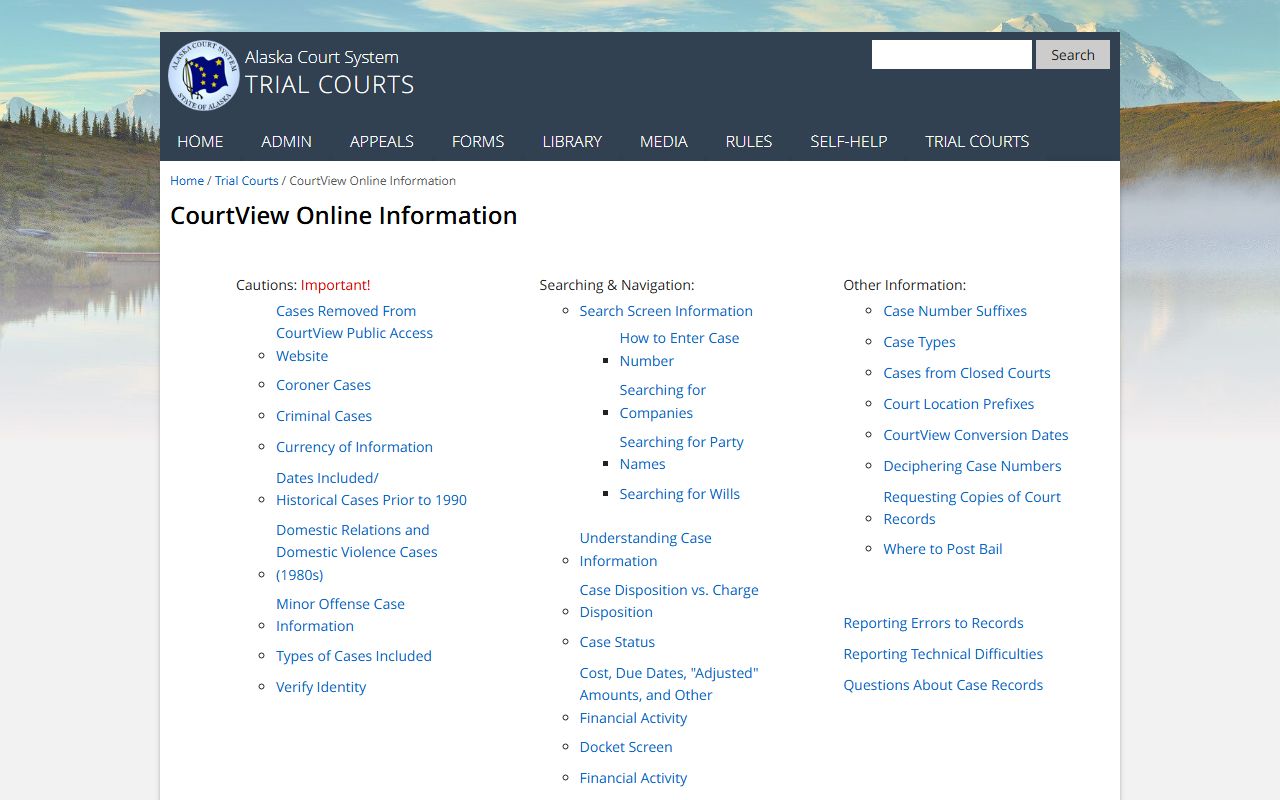
CourtView is the primary entry point for searching Alaska family court records online at no cost, accessible through the Alaska Court System's trial courts page.
How Alaska Handles Family Court Cases
Alaska does not have a separate family court. Family law cases go through the Superior Court, which is the trial court of general jurisdiction in the state. The Superior Court has authority over divorce, dissolution, custody, child support, adoption, guardianship, and other domestic relations matters. District Courts handle some related matters including domestic violence protective orders and emergency cases involving children.
The state is divided into four judicial districts. The First Judicial District covers Southeast Alaska, with the main courthouse in Juneau. The Second Judicial District serves the Nome and Arctic regions. The Third Judicial District covers Southcentral and Southwest Alaska, including Anchorage, Palmer, Kenai, and Kodiak. The Fourth Judicial District handles Interior Alaska, with courts in Fairbanks and Bethel. Which district handles your case depends on where you or your spouse lives at the time of filing.
Standing Orders take effect automatically the moment you file a domestic relations case in Alaska. These orders vary by judicial district but generally restrict both parties from selling or moving marital property, require them to keep health insurance in place, and prohibit relocating children outside Alaska without court approval or written consent from the other parent. Violating a standing order can result in contempt of court sanctions, including fines up to $5,000 or jail time.
For family court cases involving children, Alaska requires parents to complete a parent education program before the final decree is entered. Parents can watch the "Listen to the Children" video at the courthouse or complete the web-based "Children in Between" course online. Courts track this requirement. They will not finalize a case until both parents have satisfied it.
The Alaska Court System website is the starting point for locating courts, finding forms, and accessing case information across all four judicial districts.
Getting Copies of Family Court Records
If you need paper copies of Alaska family court records, you can request them in person, by mail, by fax, or by email. The form you use depends on the court location. Anchorage uses form TF-311 ANCH. Palmer uses TF-311 PA. Fairbanks uses TF-311 FBKS. All other courts use the standard TF-311 form. These forms are available at each courthouse and on the Alaska Court System forms page.
Copy fees are set by state administrative order. The first copy of any record costs $5.00. Each additional copy of the same record ordered at the same time costs $3.00. Certified copies cost $10.00 for the first copy and $3.00 for each additional certified copy of the same document. Authenticated or exemplified copies cost $15.00. If the case number is not known, the court charges a research fee of $30.00 per hour to locate the record.
Email addresses for record requests vary by location. Anchorage uses 3ANRecordsRequest@akcourts.gov. Fairbanks uses 4FArecords@akcourts.us. Palmer uses 3PACopyRequests@akcourts.gov. Juneau uses 1JUmailbox@akcourts.gov. Other courts list their own mailboxes in the court directory. For people who cannot pay fees, a fee waiver is available using form TF-920, also addressed under Administrative Order 212.
Electronic filing is available through TrueFiling for most case types. Self-represented filers are encouraged to use TrueFiling for new submissions. Some matter types such as civil protective orders, Children in Need of Aid cases, probate, and delinquency can be filed by email to the appropriate court mailbox. All courts have public access terminals during business hours where you can view records without requesting copies.
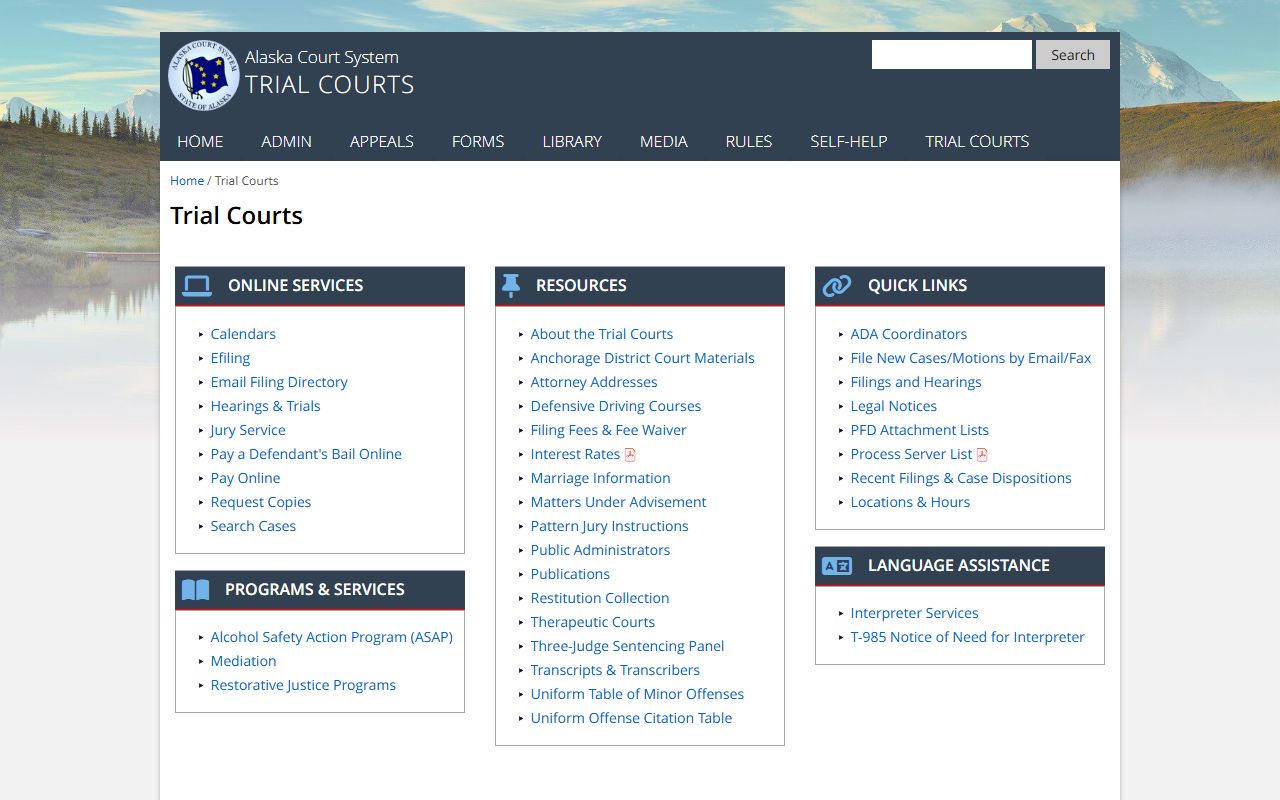
The Alaska Court System trial courts page explains the process for requesting copies of family court records and lists the correct request form for each courthouse.
Alaska Court Locations
Courts across Alaska generally operate Monday through Friday from 8:00 a.m. to 4:30 p.m., though hours vary by location. Some clerk offices have scheduled closed periods during the week for internal work. The main courthouses for family law matters are in Anchorage, Fairbanks, Juneau, Palmer, Kenai, Ketchikan, Bethel, and Kodiak.
Key courthouses for Alaska family court records include the Anchorage courthouse at 825 West 4th Avenue (phone 907-264-0514), the Fairbanks courthouse at 101 Lacey Street (phone 907-452-9277), Juneau at 123 4th Street (phone 907-463-4700), Palmer at 435 South Denali Street (phone 907-746-8181), and Kenai at 125 Trading Bay Drive (phone 907-283-3110). Ketchikan is at 415 Main Street (phone 907-225-3195), Bethel at 204 Chief Eddie Hoffman Highway (phone 907-543-2298), and Kodiak at 204 Mission Road (phone 907-486-1600).
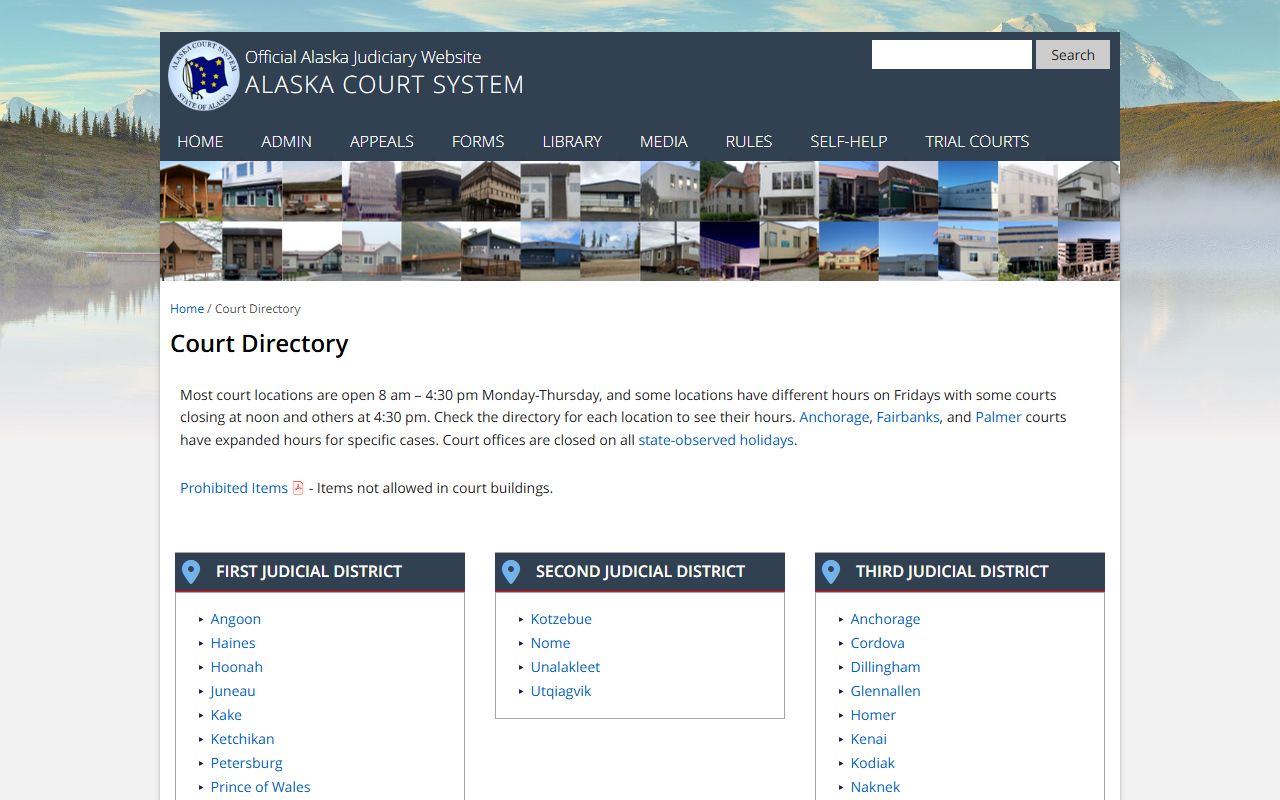
The full Alaska court directory lists every location statewide with phone numbers, addresses, and hours for each courthouse.
Alaska Family Law Statutes
Family law in Alaska is governed by Title 25 of the Alaska Statutes, which covers Marital and Domestic Relations. The key chapters include AS 25.05 (Marriage Code), AS 25.20 (Parent and Child), AS 25.23 (Adoption), AS 25.24 (Divorce and Dissolution), AS 25.25 (Uniform Interstate Family Support Act), AS 25.27 (Child Support Services), and AS 25.30 (Uniform Child Custody Jurisdiction and Enforcement Act). These statutes control how courts handle all types of family court cases in the state.
Alaska is a no-fault divorce state. Under AS 25.24, a court can grant a divorce based on "incompatibility of temperament." This means that even if one spouse does not want the marriage to end, the other can still request and receive a divorce. The court must find that the marriage is irretrievably broken. Fault-based grounds such as cruelty, abandonment, and adultery still exist under Alaska law but are less commonly used.
For custody decisions, AS 25.24.150 lists the factors courts must weigh to find the best interests of the child. These include the child's physical and emotional needs, the ability of each parent to meet those needs, the child's preference if old enough to form one, and whether each parent will support the child's relationship with the other parent. Evidence of domestic violence weighs heavily against the party who committed it. Shared custody considerations are addressed at AS 25.20.090.
Child support is calculated under Civil Rule 90.3. The calculation accounts for both parents' incomes, the custody arrangement, number of children, and health insurance costs. The Uniform Child Custody Jurisdiction and Enforcement Act, adopted at AS 25.30.300 et seq., governs which state has authority when parents live in different states and provides tools to enforce custody orders across state lines. Child support enforcement falls under the Child Support Services Division, reachable statewide at 1-800-478-3300, with offices in Anchorage (907-269-6900), Fairbanks (907-451-2890), and Juneau (907-465-3129). CSSD regulations are at 15 AAC 125.
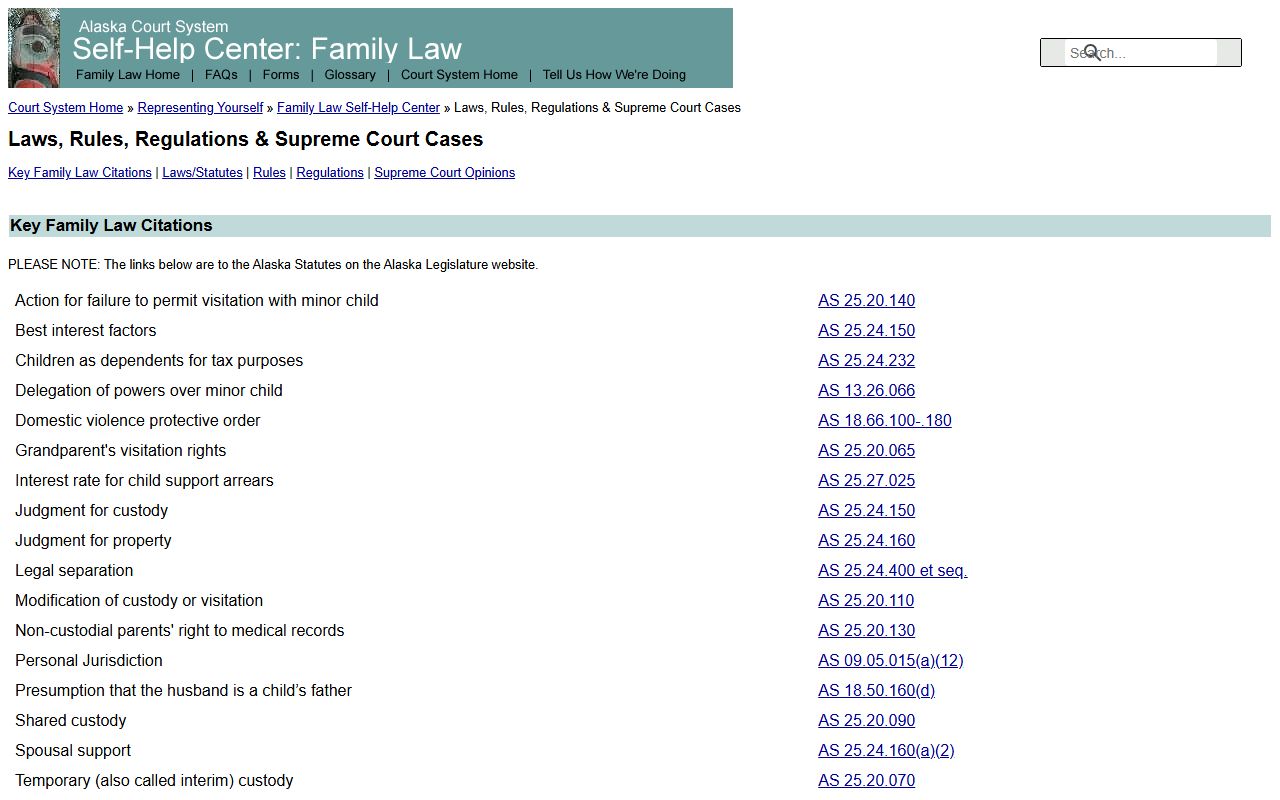
The Alaska Family Law Statutes page from the court's self-help center links to key provisions of Title 25 and court rules that govern divorce, custody, and support cases.
Family Court Forms and Self-Help Resources
The Alaska Family Law Self-Help Center provides forms and instructions for dissolution, divorce, custody, child support, and modifications. Forms are grouped into packets by situation. Packet DR-1 covers dissolution with minor children when both spouses agree. DR-2 covers dissolution without children. DR-3 applies when one spouse cannot locate the other. Separate uncontested divorce packets are available for cases where one party is filing alone.
Key forms used in Alaska family court cases include DR-100 (Petition for Dissolution, no children), DR-105 (Petition for Dissolution with children), DR-475 (Parenting Plan), DR-305 (Child Support Guidelines Affidavit), DR-306 (Shared Custody Child Support Calculation), and DR-150 (Child Custody Jurisdiction Affidavit). The VS-401 Certificate of Divorce, Dissolution or Annulment closes out a case. Form TF-920 is the fee waiver application for those who cannot afford filing costs.
Forms are available as fillable PDFs. Download and save them to your device before filling them out. Filling them in a browser can prevent changes from saving correctly. Printed copies are available at all court clerk offices. Questions can go to the Family Law Self-Help Center at (907) 264-0851, or toll-free at (866) 279-0851 for Alaska residents outside Anchorage. Forms can also be requested by email at FormsFeedback@akcourts.gov.
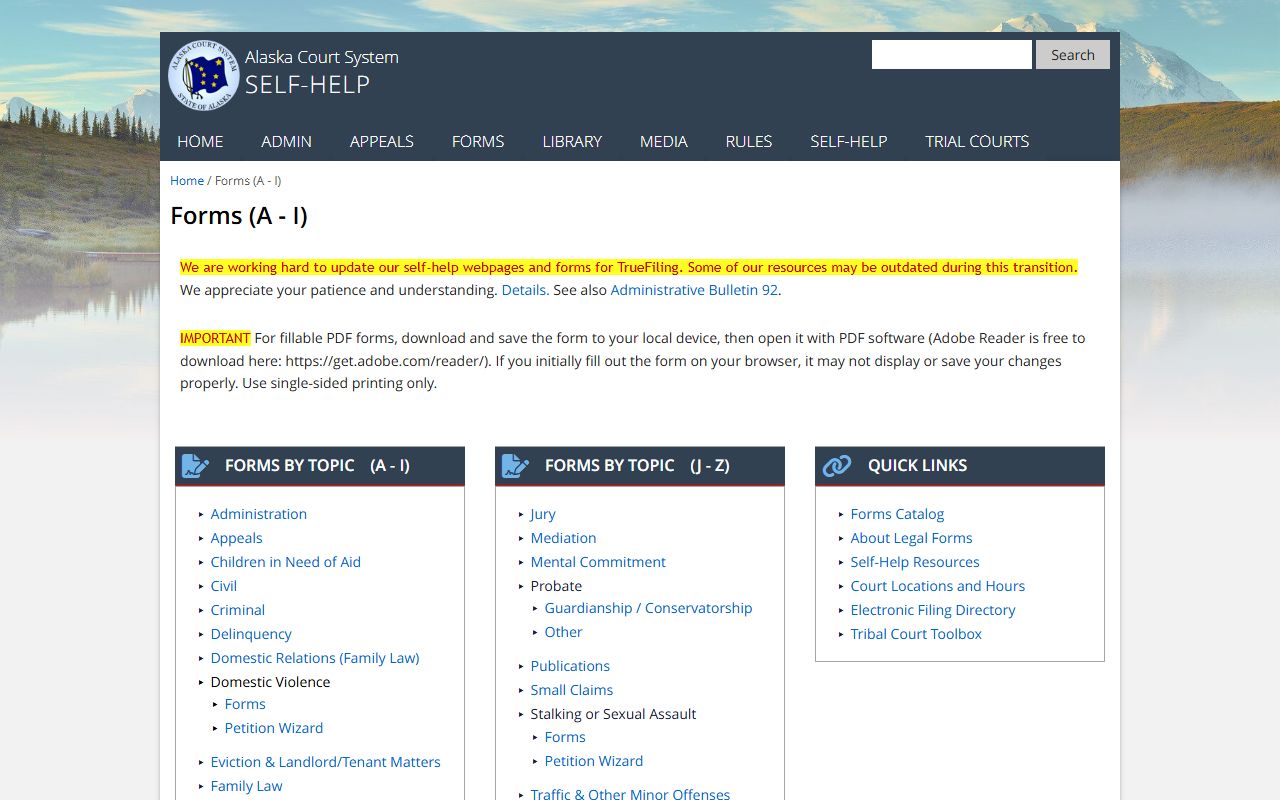
All official forms for Alaska family court cases are organized by case type in the Alaska Court System forms catalog.
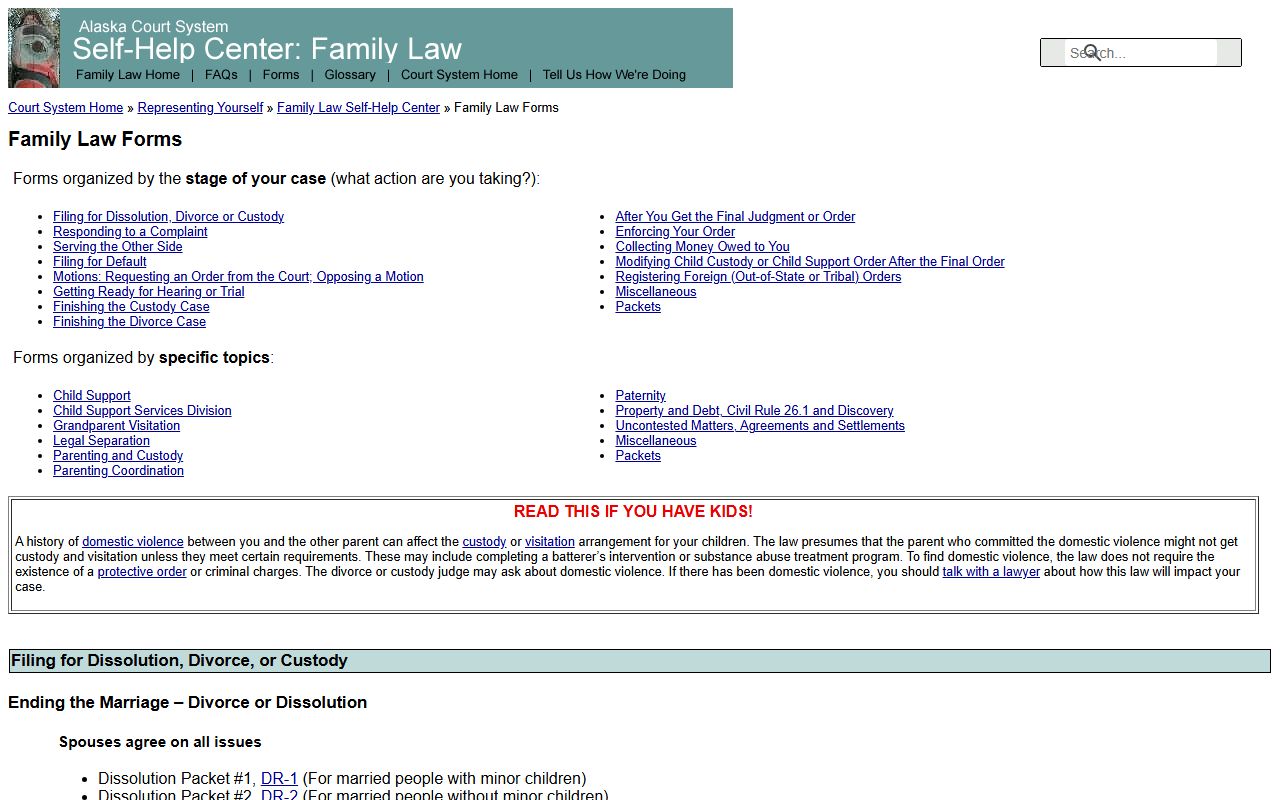
The Family Law Self-Help Center provides packet-style instructions designed for self-represented parties handling dissolution, divorce, and custody matters in Alaska.
Vital Records Connected to Family Court Cases
The Alaska Bureau of Vital Statistics, part of the Alaska Department of Health, maintains certified divorce certificates. These are separate from the case files held by court clerks. A divorce certificate becomes available after the decree is finalized and filed. These records are restricted for 50 years after the date of the event. Only qualified applicants can request copies during that period.
Qualified applicants include the people named on the record, their parents, spouses, children, siblings, legal representatives, and government agencies with a legitimate need. You must provide a valid government-issued photo ID and show a direct interest in the record as required by Alaska Statute 18.50.330. Walk-in service is available at the Juneau office at 5441 Commercial Boulevard (phone 907-465-3391) and the Anchorage office at 3901 Old Seward Highway, Ste. 101 (phone 907-269-0991). Both offices are open weekdays from 8:30 a.m. to 4:30 p.m.
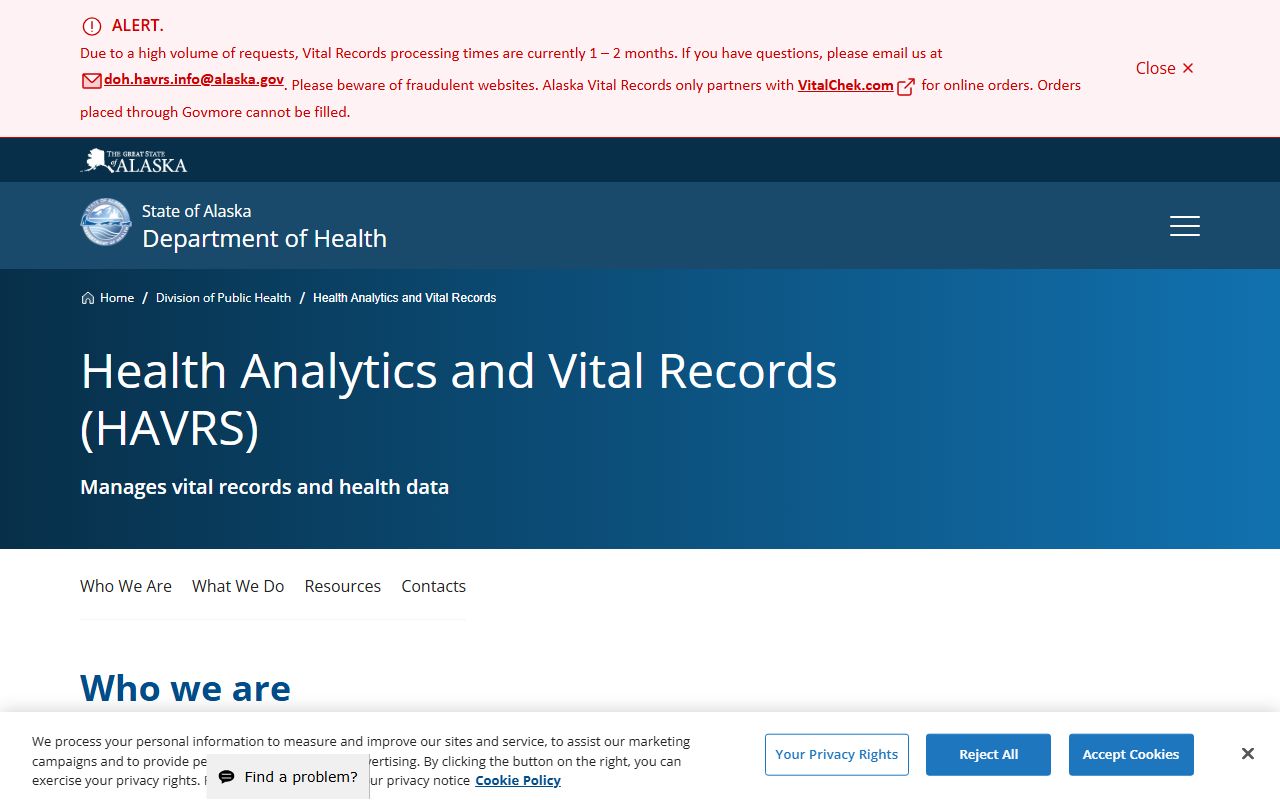
The Alaska Department of Health Vital Statistics office issues certified divorce certificates after a case reaches final judgment.
Historical Records and the State Archives
For Alaska family court records from the territorial period or cases filed before 1990 that are not in CourtView, the Alaska State Archives is the place to start. The archives holds court journals, probate records, naturalization records, and case files from the territorial court system. It has most territorial court records for the First Judicial District covering the Juneau area, and some records for the Second and Fourth Districts.
The Alaska State Archives is at 141 Willoughby Avenue, Juneau, Alaska 99801. Research hours are Monday through Friday, 8:00 a.m. to 4:30 p.m. Contact the archives in advance to confirm that specific records are on site. Some territorial period records are held at the National Archives Alaska Region rather than the state archives. Adoption records and juvenile records remain restricted regardless of age.
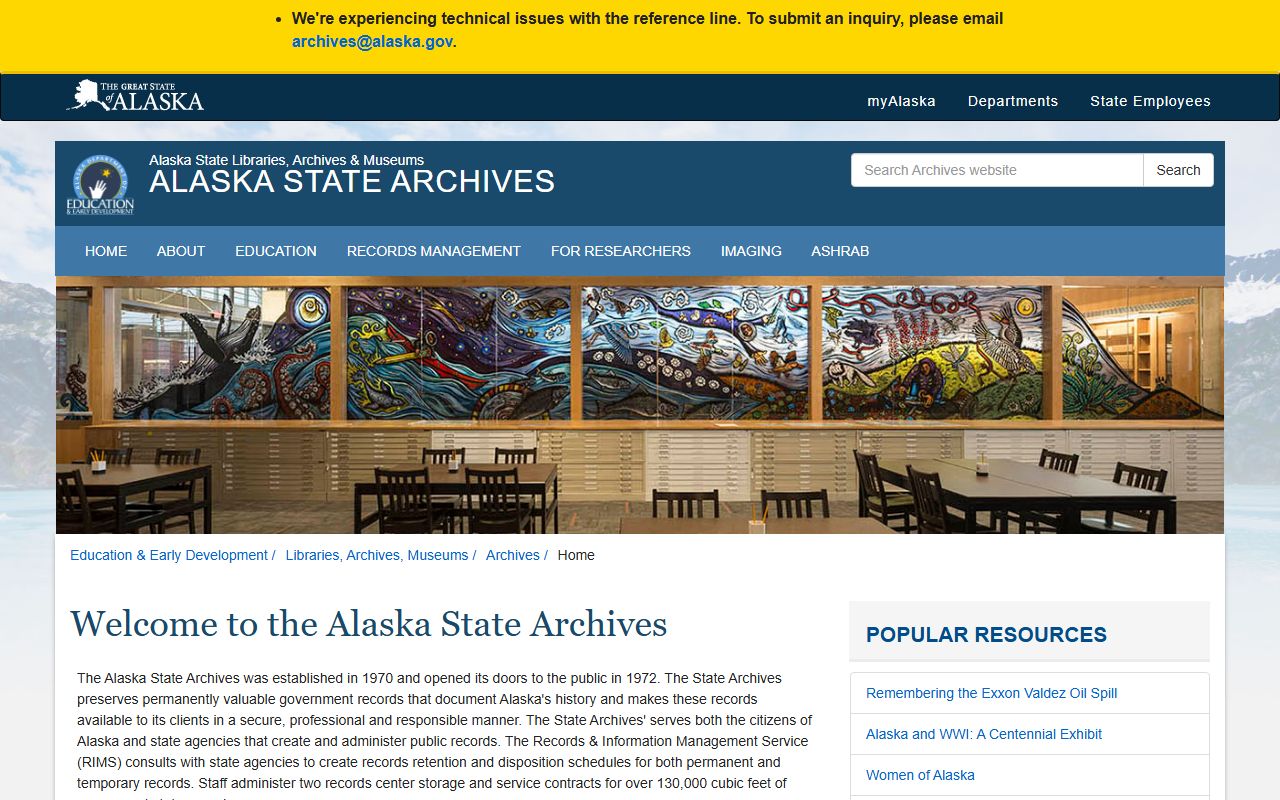
The Alaska State Archives in Juneau holds historical court records from the territorial period and early statehood not available through CourtView.
Appellate Courts and Published Family Law Opinions
When a family court case is appealed, it goes to the Alaska Supreme Court. The Supreme Court is the highest court in the state and hears appeals from all lower courts. It issues slip opinions every Friday after 9:00 a.m. These are posted on the court website until published in the Pacific Reporter and Alaska Reporter. Memorandum Opinions and Judgments are issued Wednesday mornings and carry no precedential effect. The Appellate Clerk's Office is at 303 K Street in Anchorage, phone (907) 264-0608. Alaska case law from 1960 forward is available for free through the Alaska Case Law Service at government.westlaw.com/akcases/.
The Alaska Court of Appeals was created in 1980. It handles appeals in criminal cases, post-conviction relief, juvenile delinquency, and sentencing matters. Most civil family law appeals, including divorce and custody cases, go directly to the Supreme Court rather than the Court of Appeals. Published Supreme Court opinions on family law issues interpret Title 25 and Civil Rule 90.3 and serve as binding precedent for all lower courts across Alaska.
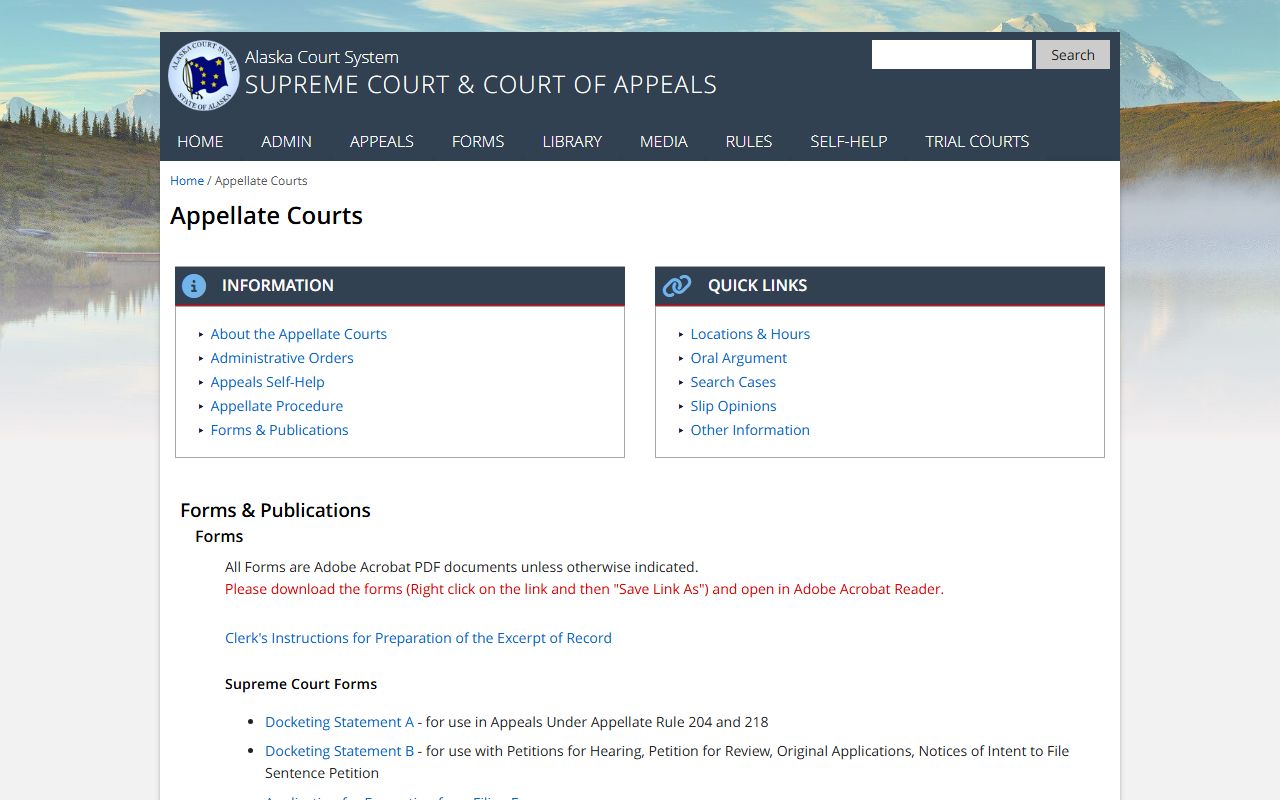
The Alaska Appellate Courts page provides access to slip opinions, court schedules, and contact information for the Supreme Court and Court of Appeals.
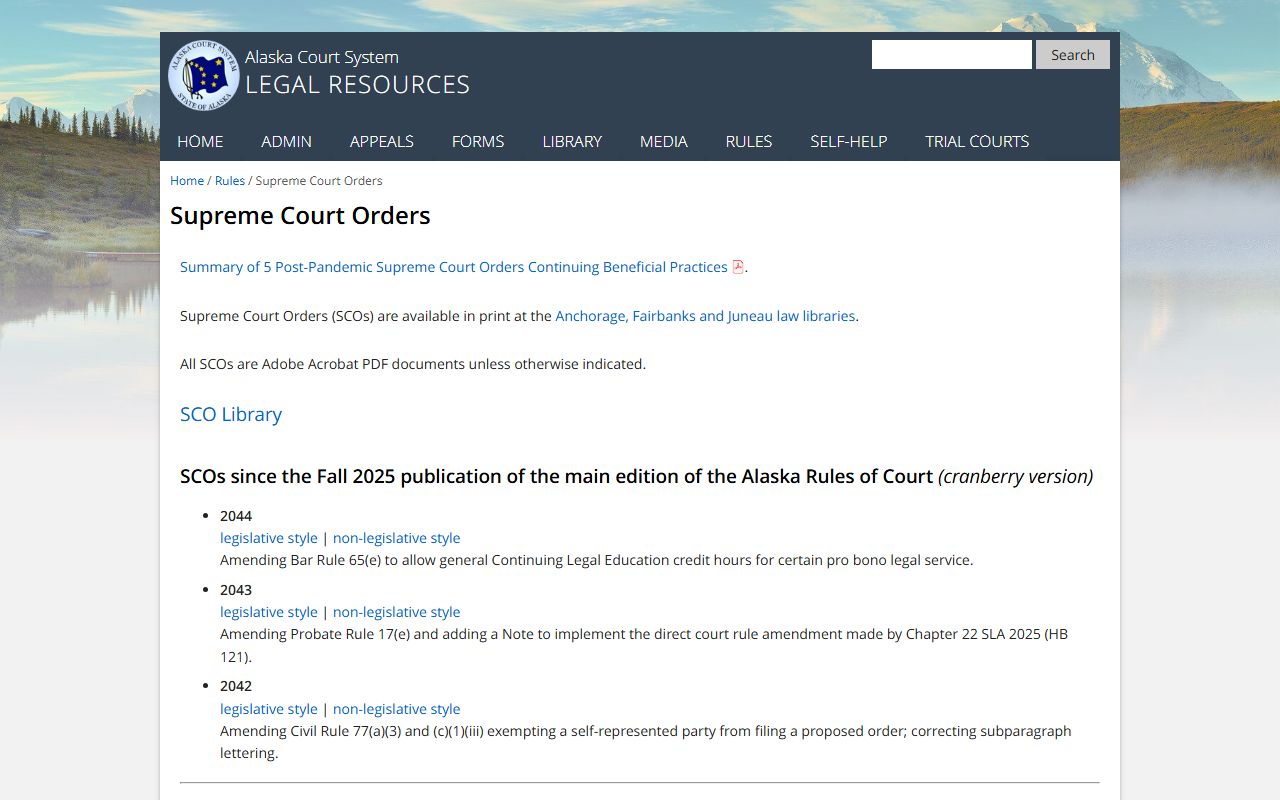
Published family law opinions from the Alaska Supreme Court interpret the statutes governing divorce, custody, and support and serve as binding precedent for every court in the state.
Browse by Location
Alaska Counties and Boroughs
Family court cases in Alaska are filed at the Superior Court serving the judicial district where you live. Each borough or census area falls under one of the four judicial districts. Browse by county to find local court contact information and family court records access details.
Major Alaska Cities
Find family court records information for cities across Alaska. Each city page links to the court and resources that serve that community directly.